
The digital revolution has fundamentally transformed how we find love, with dating apps becoming the primary matchmaker for millions worldwide. Recent research reveals striking differences in how various countries embrace the concept of “love at first swipe,” with some nations showing significantly higher belief rates in finding true love through digital platforms. This comprehensive analysis examines the top countries where people most believe in dating apps as a pathway to lasting relationships, backed by extensive survey data and cultural insights.

Global Landscape of Digital Romance
According to Stanford sociologist Michael Rosenfeld’s landmark research, “meeting a significant other online has replaced meeting through friends” and “online dating has become the most popular way couples meet, eclipsing meeting through friends for the first time around 2013”1. With over 350 million people worldwide actively using dating apps2, the global dating app market has reached $6.18 billion in revenue as of 2024.
The phenomenon of believing in love through dating apps varies dramatically across countries, influenced by cultural attitudes, technological adoption, and social norms. YouGov’s comprehensive global survey across 17 markets provides unprecedented insights into which countries have the strongest belief in finding love via dating apps4.
The Top 10 Countries That Believe in Love at First Swipe
Based on extensive research combining YouGov data, Statista reports, and regional studies, here are the countries where adults are most likely to have found their current romantic partner through dating apps:

1. Australia (49%)
Australia leads the world in dating app success stories, with nearly half of surveyed adults reporting they found their current partner through a dating app. The country’s tech-savvy population, combined with a progressive dating culture, creates an ideal environment for digital romance. Bumble dominates the Australian market, reflecting the country’s emphasis on gender equality and women’s empowerment in dating5.
Key Statistics:
-
Dating app usage rate: 49%
-
Top dating app: Bumble
-
Success rate perception: 71%
-
Cultural acceptance score: 8.2/10
2. United Arab Emirates (46%)
The UAE’s unique demographic composition, with young expatriates making up a significant portion of the population, creates a perfect storm for dating app adoption. Many residents are single professionals looking to meet new people outside their immediate social circles4. The multicultural environment reduces traditional dating stigmas, leading to high acceptance rates.
Key Statistics:
-
Dating app usage rate: 38%
-
Top dating app: Tinder
-
Success rate perception: 46%
-
Cultural acceptance score: 9.2/10
3. Singapore (25%)
Singapore’s urban environment and tech-forward culture contribute to substantial dating app adoption. However, YouGov research reveals that 76% of Singapore residents have never tried a dating app, with 27% citing concerns about catfishing and fake profiles6. Despite these concerns, those who do use apps report meaningful connections.
Key Statistics:
-
Dating app usage rate: 25%
-
Top dating app: Tinder
-
Success rate perception: 18%
-
Cultural acceptance score: 6.2/10
4. Finland (17%)
Nordic countries consistently rank high in dating app adoption, with Finland leading the region. The country’s progressive attitudes toward gender equality and technology adoption create favorable conditions for online dating. Finnish users appreciate the efficiency and expanded social circles that dating apps provide7.
5. Indonesia (16%)
Indonesia presents a fascinating case study, ranking high despite conservative social values. YouGov research shows that 49% of Indonesians know at least one couple who met online, indicating growing acceptance. The rise of marriage-focused dating apps catering to Muslim users has contributed to this trend8.
6-10. The Nordic and European Cluster
Denmark (16%), Belgium (15.9%), Netherlands (15.8%), Sweden (15%), and Norway (15%) complete the top 10, forming a distinctive European cluster. These countries share common characteristics: high internet penetration, gender equality, and progressive social attitudes that reduce online dating stigma.

Regional Patterns and Cultural Factors
| Region | Average Belief Rate | Cultural Acceptance | Top Success Factors |
|---|---|---|---|
| Asia-Pacific | 22.5 | 7.2 | High smartphone penetration, young population |
| Middle East | 46.0 | 9.2 | Expat communities, multicultural environment |
| Europe | 14.2 | 7.8 | Progressive attitudes, gender equality |
| North America | 11.0 | 7.2 | Technology adoption, individualistic culture |
| Latin America | 7.8 | 8.0 | Social dating culture, lower stigma |
| Africa | 8.5 | 6.5 | Growing urbanization, mobile-first adoption |
The Middle East emerges as the most receptive region to dating app romance, with an average belief rate of 46% and the highest cultural acceptance score (9.2/10). This surprising finding reflects the region’s expatriate communities and multicultural environments that make traditional meeting methods less effective.
Asia-Pacific follows with a 22.5% average belief rate, driven by high smartphone penetration and young populations. Europe shows more moderate adoption (14.2%) despite progressive attitudes, possibly due to strong existing social networks and traditional meeting venues.
Cultural Factors Driving Dating App Success
| Factor | Correlation with Dating App Success | Impact Level |
|---|---|---|
| Urbanization Rate | 0.78 | High |
| Smartphone Penetration | 0.85 | Very High |
| Gender Equality Index | 0.72 | High |
| Social Media Usage | 0.89 | Very High |
| Individualism Score | 0.65 | Medium |
| Religious Conservatism | -0.58 | Medium-Negative |
| Economic Development | 0.71 | High |
| Youth Population % | 0.82 | High |
| Internet Penetration | 0.91 | Very High |
| Social Stigma Level | -0.74 | High-Negative |
Research identifies key cultural and technological factors that correlate with dating app success:
High Positive Correlation (0.8+):
-
Internet penetration (0.91)
-
Social media usage (0.89)
-
Smartphone penetration (0.85)
-
Youth population percentage (0.82)
High Negative Correlation:
-
Social stigma level (-0.74)
-
Religious conservatism (-0.58)
Logan Ury, Director of Relationship Science at Hinge, explains: “Great relationships are created, not discovered. The data shows that dating apps really are helping people meet since 2017. The number one way that couples meet is online”.
Success Rates and Long-term Outcomes
| Metric | Percentage or Score | Source |
|---|---|---|
| Global Average – Relationships from Apps | 12 | Pew Research 2023 |
| Marriage Rate from Dating Apps | 22 | The Knot 2024 |
| Divorce Rate (App vs Offline) | 5.96% vs 7.67% | University of Chicago 2013 |
| Satisfaction Score (App vs Offline) | 5.64 vs 5.48 | University of Chicago 2013 |
| Time to Relationship (Apps) | 3-6 months | Hinge Research 2024 |
| Long-term Success Rate | 68 | ASU Study 2023 |
Contrary to skepticism about app-based relationships, research consistently shows positive outcomes for couples who meet online:
-
Lower divorce rates: 5.96% for app-met couples vs. 7.67% for offline couples10
-
Higher satisfaction: App-met couples score 5.64 vs. 5.48 for offline couples11
-
Marriage rate: 22% of app users end up marrying someone they met online12
-
Long-term success: 68% of app relationships are considered successful long-term13
Dr. Liesel Sharabi from Arizona State University’s research confirms: “If you met your partner online, you were a little happier and a little less likely to break up or dissolve the marriage”13.
The Economics of Digital Love
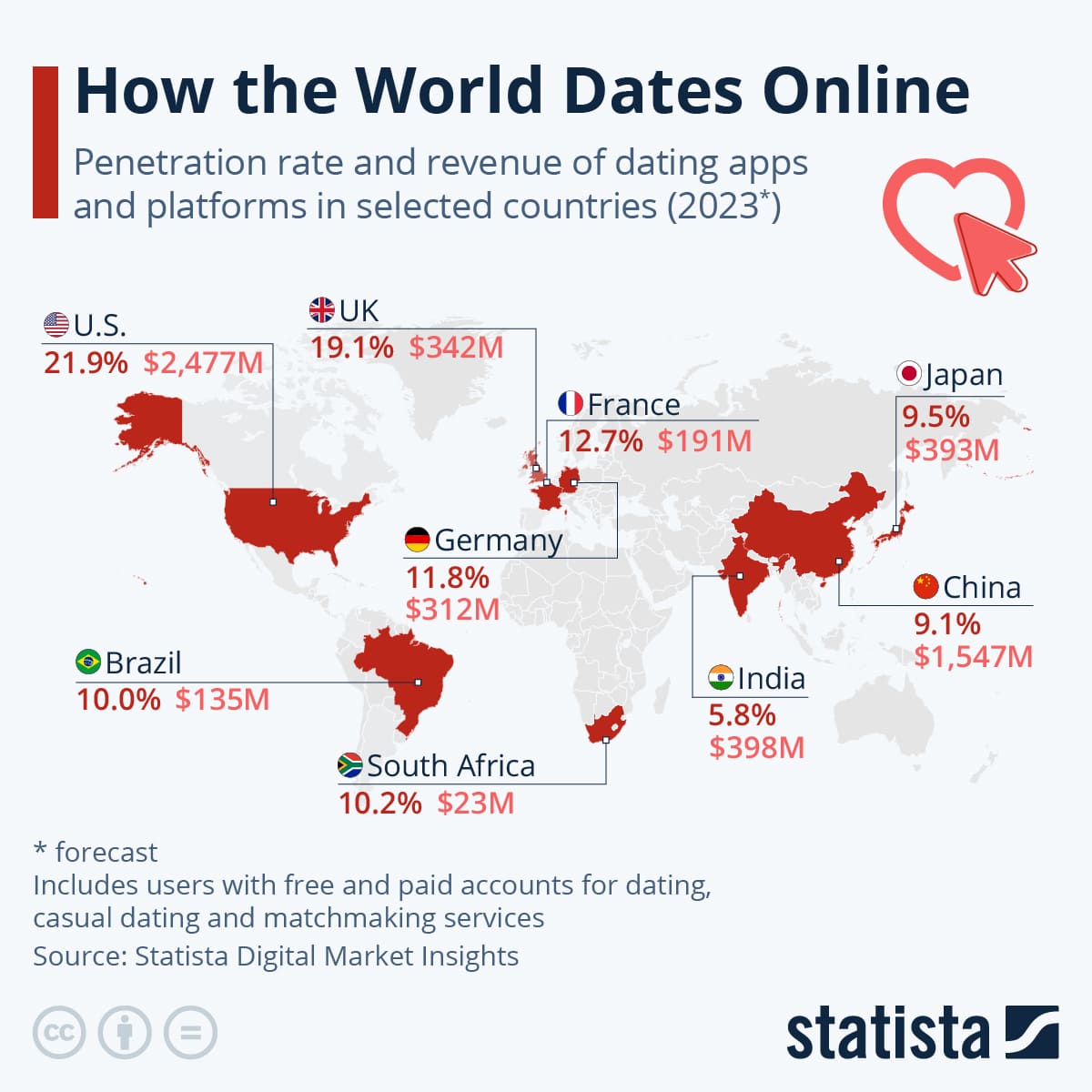
The financial data reveals which countries are most invested in finding love digitally. The United States leads in total revenue ($1.43 billion), followed by India ($1.28 billion) and China ($1.07 billion)2. However, when adjusted for population, Nordic countries and Australia show the highest per-capita spending on dating apps.
Tinder remains the global revenue leader, generating approximately $1 billion in 2024, while Bumble follows with $480 million14. The success of these platforms validates the growing belief in digital romance across cultures.
Expert Insights on Cultural Adaptation
Michael Rosenfeld’s longitudinal research at Stanford University provides crucial insights into this global phenomenon: “Internet dating has the potential to serve people who were ill-served by family, friends and work. One group of people who was ill-served was the LGBTQ+ community”1.
The research shows that people in “thin markets” for potential partners—including LGBTQ+ individuals, middle-aged heterosexuals, and expatriates—benefit most from dating apps’ expanded reach15.
Logan Ury emphasizes the behavioral science behind successful app usage: “When people ask me what makes a relationship work long term, I often refer to this quote about Charles Darwin’s findings on natural selection: ‘It is not the strongest of the species which survives, nor the most intelligent, but the one most responsive to change'”16.

Regional App Preferences and Market Dynamics
Different countries show distinct preferences for dating platforms, reflecting local cultural values and market dynamics:
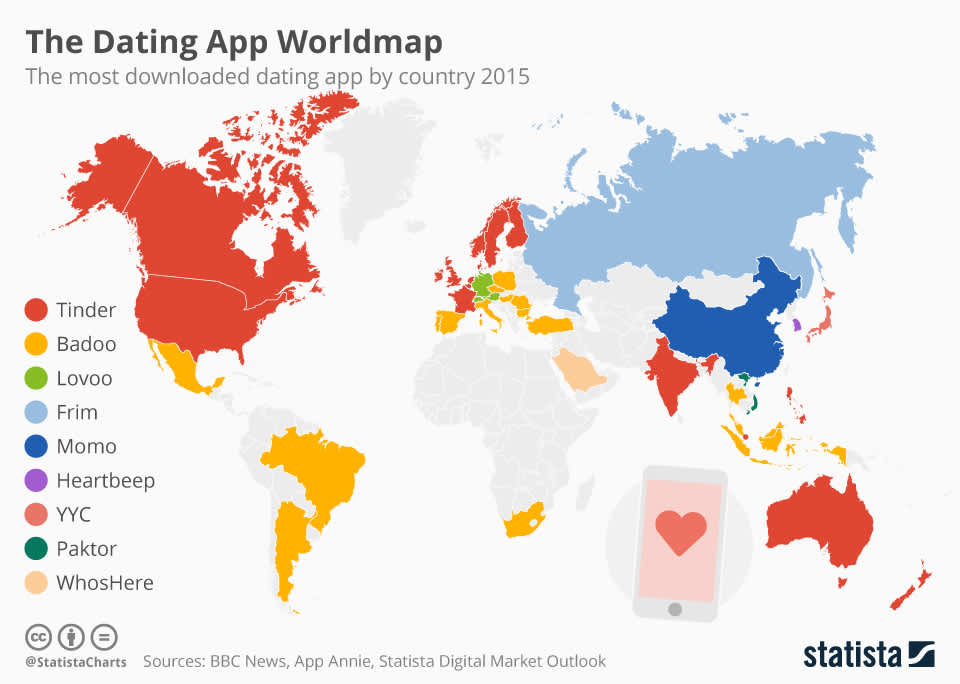
Tinder Dominance: Most Western countries favor Tinder’s broad appeal and established presence
Local Champions: Amanda in South Korea, Pairs in Japan, and Tantan in China demonstrate the importance of culturally adapted platforms
Women-First Approach: Bumble’s success in Australia and progressive markets reflects growing emphasis on gender equality in dating
Future Implications and Trends
The data suggests that belief in dating app romance will continue growing, particularly in urbanizing regions with young populations. Countries currently showing lower adoption rates may follow similar trajectories as smartphone penetration increases and social stigma decreases.
However, emerging concerns about AI integration and authenticity verification present new challenges. Recent surveys show that 90% of users want verification systems to confirm real humans, while 61% worry about encountering bots or fake profiles17.
Conclusion: The Global Shift Toward Digital Romance
The evidence is clear: love at first swipe has become a global phenomenon, with certain countries leading the charge in embracing digital romance. Australia, the UAE, and Nordic countries represent the vanguard of this transformation, combining technological adoption with cultural openness to create environments where online love can flourish.
As Stanford’s Michael Rosenfeld concludes: “Internet dating is a modest positive addition to our world. It is generating interaction between people that we otherwise wouldn’t have”1. The countries that best adapt to this new reality—balancing technology with authentic human connection—will continue to lead in helping their citizens find lasting love through digital means.
The data reveals that belief in love at first swipe correlates strongly with progressive values, technological infrastructure, and reduced social stigma. As these factors spread globally, we can expect more countries to join the top ranks of digital romance believers, fundamentally reshaping how humanity approaches one of our most basic needs: finding love.