
The digital dating landscape has fundamentally transformed how people meet romantic partners, with dating apps becoming the predominant method for relationship formation in the 21st century. This comprehensive analysis examines the actual success rates of finding love through dating platforms, revealing both the promise and limitations of algorithmic matchmaking.
he digital dating landscape has fundamentally transformed how people meet romantic partners, with dating apps becoming the predominant method for relationship formation in the 21st century. This comprehensive analysis examines the actual success rates of finding love through dating platforms, revealing both the promise and limitations of algorithmic matchmaking.
Key Takeaways
-
27% of engaged couples met through dating apps, making them the most common way to meet partners
-
Hinge leads with 36% marriage success rate, followed by Tinder (25%) and Bumble (22%)
-
Overall success rate for meaningful relationships is 2.5%, highlighting the need for realistic expectations
-
79% of users experience dating app burnout, suggesting the need for strategic, limited use
-
Men have higher positive experiences (57%) than women (48%), but women form relationships more successfully
-
LGB users achieve 61% positive experiences, the highest of any demographic group
-
Regional and cultural factors significantly influence success rates, with individualistic cultures showing higher adoption
-
Algorithm effectiveness is limited, with human factors remaining more important than matching technology
-
User motivation and approach strategy are stronger predictors of success than platform choice alone

Executive Summary: The Reality of Dating App Success
The question “how often do people find love on dating apps” yields a complex answer that varies significantly by platform, demographics, and definitions of success. While 27% of engaged couples now meet through dating apps, the overall success rate for meaningful long-term relationships stands at just 2.5%, highlighting the substantial gap between widespread usage and actual relationship formation123.

Key Findings at a Glance
Love Success Rate by App
Hinge: 36% of marriages among engaged couples
Tinder: 25% of marriages among engaged couples
Bumble: 22% of marriages among engaged couples
Match: 8% of marriages among engaged couples
eHarmony: 5% of marriages among engaged couples
The Current State of Dating App Success Rates
Platform-Specific Success Metrics
Dating app effectiveness varies dramatically across platforms, with relationship-focused apps consistently outperforming swipe-based alternatives. According to The Knot’s 2024 study of nearly 8,000 engaged couples, Hinge leads all platforms with 36% of couples who met online, followed by Tinder at 25% and Bumble at 22%3. This data represents a significant shift from casual dating platforms toward more intentional relationship-building apps.

Psychologist Eli Finkel from Northwestern University, who has extensively studied online dating effectiveness, notes that “the biggest benefit of online dating is that it introduces you to tons of people you otherwise wouldn’t have met”4. However, his research suggests that matching algorithms don’t significantly improve compatibility prediction beyond simple demographic filters.
The Broader Success Landscape
While platform-specific marriage rates paint an optimistic picture, the overall statistics reveal a more sobering reality. Research indicates that only 10% of partnered adults met their current significant other through dating apps2. Among younger demographics, this figure rises to 20% for adults under 30, suggesting generational differences in dating app effectiveness2.
The Marriage Foundation’s 2021 study found that couples who meet online face unique challenges, with 12% divorcing within three years compared to just 2% of couples who met offline56. Research Director Harry Benson explains: “Online marriages are significantly more vulnerable early on… the multifaceted, subconscious trawl for information that naturally takes place with traditional meeting methods is somehow blunted with the online system”6.
Demographic Patterns in Dating App Success
Age and Dating App Effectiveness
Age significantly influences both usage patterns and success rates on dating platforms. The 25-34 age group represents 45% of all dating app users, making it the largest demographic segment7. However, success rates vary considerably across age groups, with adults under 30 achieving a 20% success rate in meeting their current partner online, compared to just 6% for adults over 508.

Dr. Logan Ury, Director of Relationship Science at Hinge and author of “How to Not Die Alone,” emphasizes that “age is the variable that most strongly predicted higher satisfaction with Tinder-generated offline dates”9. Her research suggests that older users approach dating apps with more realistic expectations and tend to be more selective in their matching behavior.
Gender Disparities in Dating App Success
The gender imbalance on dating platforms creates vastly different experiences for male and female users. Men comprise 75% of dating app users, creating a challenging environment where women have a 10% match rate while men achieve only 0.6%7. This disparity significantly impacts success rates and user satisfaction.
Men report more positive experiences with dating apps at 57% compared to 48% for women2. However, women who do engage successfully are more likely to form lasting relationships, with female users showing higher rates of relationship formation once initial connections are made10.
LGBTQ+ Community Success Rates
The LGBTQ+ community demonstrates notably higher success rates on dating platforms. LGB users report 61% positive experiences compared to 53% for straight users2. More significantly, 24% of LGB partnered adults met their current partner online, compared to just 9% of straight adults2.
This success can be attributed to dating apps providing safer spaces for LGBTQ+ individuals to connect without the potential risks of in-person encounters in less accepting environments. Grindr and HER, while having smaller overall user bases, show higher engagement rates within their target demographics2.
Regional and Cultural Variations in Dating App Success
Global Usage Patterns
Dating app penetration varies significantly across regions, reflecting cultural attitudes toward online dating and technological adoption. The United States leads with 21.9% population penetration, followed by the United Kingdom at 19.1% and Belgium at 15.9%11.
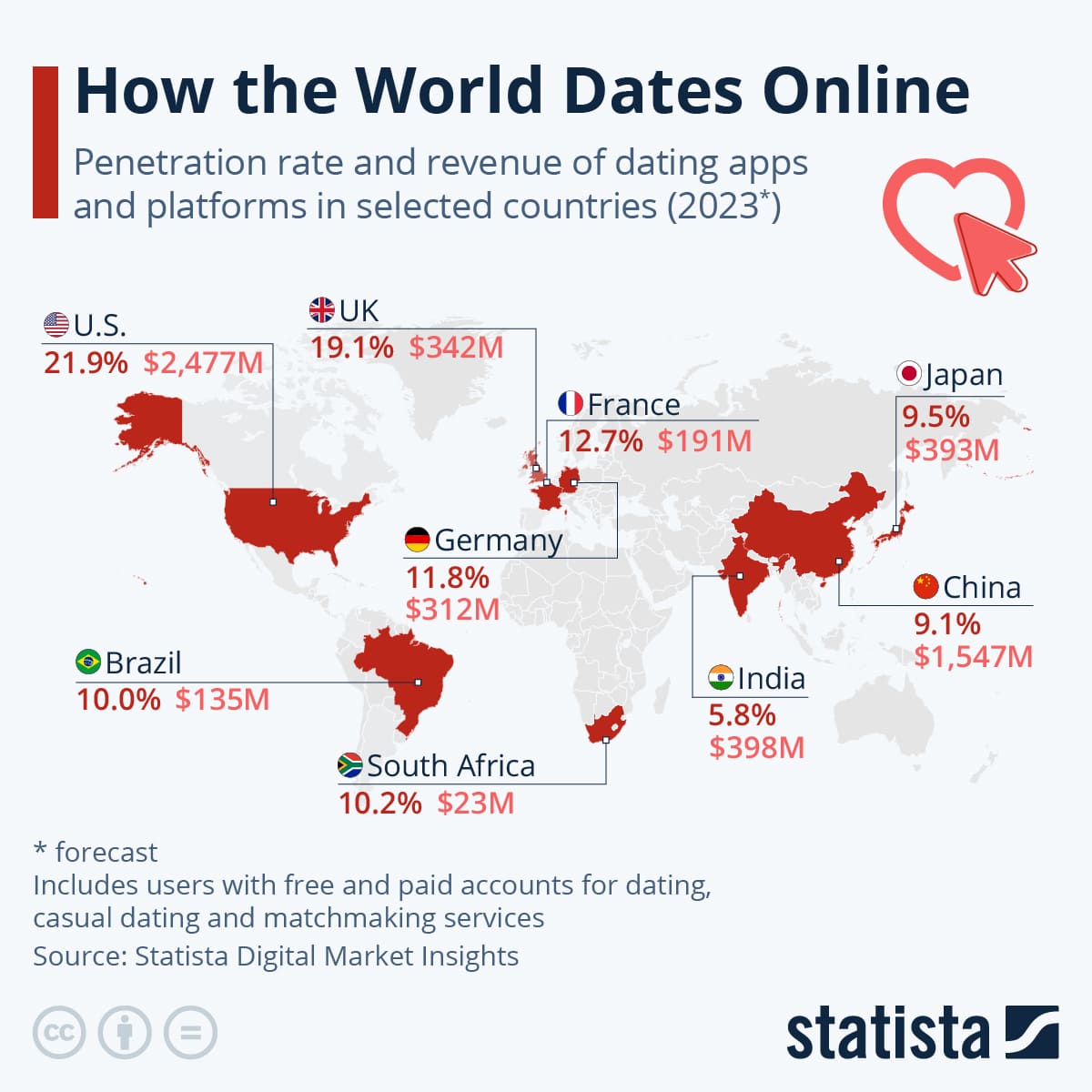
Cultural factors significantly influence success rates. In countries with more individualistic cultures like the United States, dating apps align well with personal autonomy expectations. Conversely, in family-oriented societies like India (9.1% penetration), traditional meeting methods still predominate12.
Platform Preferences by Region
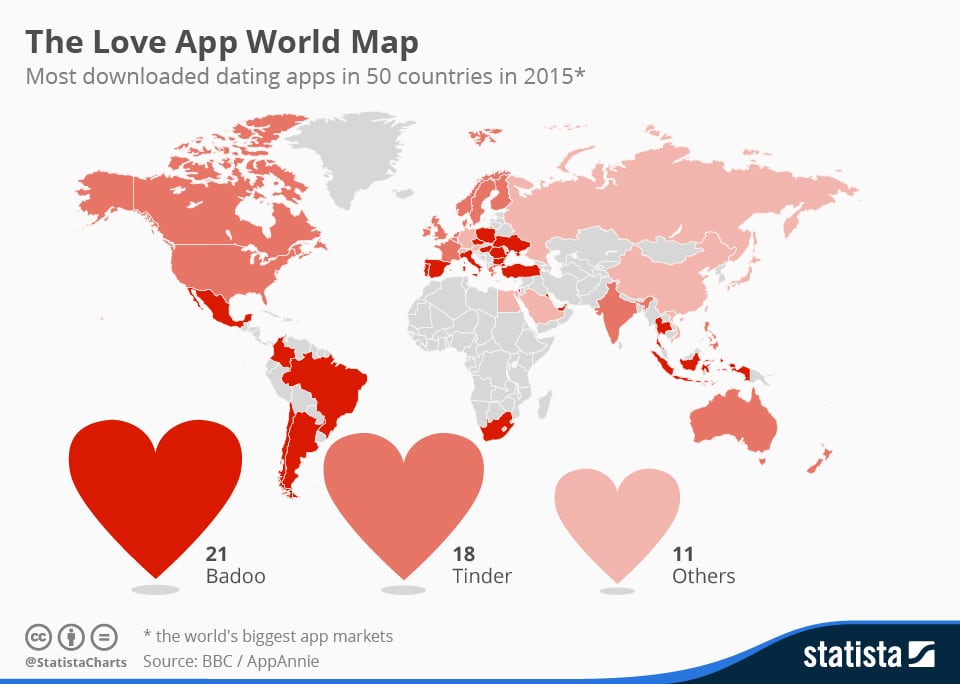
Regional preferences reveal interesting cultural patterns. Badoo dominates in 21 countries, particularly in Latin America and parts of Europe, while Tinder leads in 18 countries, primarily in North America and Northern Europe13. These preferences often reflect local dating customs and cultural values.
Dr. Michael Rosenfeld from Stanford University, whose research tracks how couples meet, notes that “online dating has become the most common way heterosexual couples meet in the United States,” with 39% of couples meeting online as of 201714. This trend has only accelerated, with recent data showing 45% of couples now meeting through digital platforms15.
Historical Evolution of Dating App Success
The Transformation from Novelty to Necessity
The dating app industry has evolved from a niche market to a $6.18 billion industry in 2024, with over 350 million global users16. This growth reflects not just technological advancement but a fundamental shift in social norms around digital dating.
| Year | Online Dating Usage (%) | Couples Met Online (%) | Dating App Revenue ($B) | Key Milestone |
|---|---|---|---|---|
| 2009 | 11 | 22 | 1.2 | Early adoption |
| 2015 | 15 | 35 | 1.6 | Smartphone era |
| 2017 | 30 | 39 | 2.8 | Mainstream acceptance |
| 2019 | 30 | 40 | 4.2 | Peak growth |
| 2022 | 30 | 42 | 5.8 | Pandemic boost |
| 2024 | 32 | 45 | 6.18 | Maturation |
Success rates have remained relatively stable despite massive user growth. The 2.5% success rate for meaningful relationships has persisted even as total users have increased exponentially1. This suggests that while dating apps excel at facilitating initial connections, the fundamental challenges of relationship formation remain unchanged.
Industry revenue growth from $1.2 billion in 2009 to $6.18 billion in 2024 reflects monetization strategies rather than improved success rates16. Apps have increasingly adopted freemium models that require payment for enhanced features, potentially impacting user success based on financial investment.
The Psychology of Dating App Success and Failure
User Motivation and Outcomes
Research reveals that user motivation significantly impacts success rates. 44% of users seek long-term partners while 40% pursue casual dating2. However, Logan Ury’s research at Hinge found that users with clear relationship goals achieve higher satisfaction rates than those with ambiguous intentions9.
Stanford Medicine research discovered that half of Tinder users aren’t actually interested in meeting offline, with nearly two-thirds already in relationships9. This finding explains the disconnect between high usage rates and relatively low success rates for relationship formation.
The Burnout Phenomenon

Dr. Elias Aboujaoude from Stanford Medicine, who studied dating app psychology, warns that “online dating is an ineffective coping mechanism for those facing mental health challenges”9. His research suggests that users employing dating apps to cope with negative emotions report lower satisfaction and poorer outcomes.
The Role of Algorithms in Success
Despite marketing claims, research consistently shows that matching algorithms provide minimal improvement over basic demographic filtering. Northwestern University’s Eli Finkel concluded that “there’s no evidence that matching algorithms work” beyond introducing users to larger pools of potential partners4.
OkCupid’s experiments revealed that users told they were highly compatible behaved as if they were, regardless of actual compatibility scores20. This placebo effect suggests that algorithm effectiveness may be more psychological than mathematical.
Expert Perspectives on Dating App Effectiveness
Academic Research Insights
Dr. Liesel Sharabi from Arizona State University’s Relationships and Technology Lab found that “marriages originating from online dating platforms differ in satisfaction and stability compared to those formed through traditional offline means”21. Her research indicates that online-origin marriages report lower levels of satisfaction but still rate above neutral on quality scales.
Behavioral scientist Logan Ury emphasizes the importance of approach: “F*ck the spark and go after the slow burn. A lot of the best people out there are people who other people overlooked because they don’t spark on a first date”22. This perspective challenges the instant-gratification culture that dating apps often promote.
Industry Expert Opinions
Hunt Ethridge, a dating coach who works with male clients, notes that “learning to make women smile and laugh” is crucial for success, emphasizing that dating apps reward those who can translate online chemistry into engaging real-world interactions23.
Stephanie Rodgers, founder of the dating app Verb, argues that “dating apps are designed to be a miserable experience” because “they have little incentive to make dating more efficient—they need people to fail in order to get them to spend more money”24. This business model critique highlights the tension between user success and company profitability.
Platform-Specific Success Analysis
Hinge: The Relationship-Focused Leader
Hinge’s “designed to be deleted” philosophy appears to translate into measurable success. The platform reports that 90% of users have positive first dates and 72% want second dates3. These metrics significantly exceed industry averages and align with Hinge’s 36% share of marriages among engaged couples3.
Hinge’s success formula emphasizes detailed profiles with prompts that encourage meaningful conversation starters. Logan Ury’s research shows that this approach leads to higher-quality matches and improved user satisfaction compared to swipe-based alternatives25.
Tinder: High Volume, Moderate Success
Despite its casual reputation, Tinder facilitates 25% of marriages among couples who met online3. With 75 million monthly active users and 97 billion matches to date, Tinder’s success comes from sheer volume rather than sophisticated matching7.
Tinder’s business model focuses on engagement rather than relationship success. Average user session length of 90 minutes and multiple daily logins suggest that the app succeeds at maintaining user interest even if relationship outcomes are mixed7.
Bumble: Women-First Approach
Bumble’s women-message-first model creates a different dynamic that appeals to users seeking more respectful interactions. The platform’s 22% marriage success rate among engaged couples reflects its positioning between casual and serious dating3.
Bumble’s CEO Whitney Wolfe Herd recently announced plans to use AI for pre-screening potential matches, allowing user personas to “date” each other before humans interact26. This innovation addresses the efficiency concerns that plague current dating app models.
The Economics of Dating App Success
Revenue Models and User Success
The dating app industry’s $6.18 billion revenue primarily comes from subscription fees and premium features16. This creates a potential conflict between user success and business sustainability, as successful users who find relationships presumably stop using the service.
Premium feature adoption varies significantly by platform. eHarmony and Match users are more likely to pay for advanced features, reflecting their serious relationship intentions23. Tinder’s freemium model generates revenue through volume, with 8 million paying subscribers among its 75 million monthly users7.
The Cost of Success
Professional dating coaching can cost between hundreds to thousands of dollars, with some users investing $15,000 or more in comprehensive services27. While expensive, coached users often report dramatically improved results, suggesting that strategic approach significantly impacts outcomes.
Dating app premium subscriptions typically range from $10-$50 monthly, with men more likely to pay for features than women (41% vs. 29%)2. This investment disparity may contribute to the gender differences in success rates.
Future Trends and Predictions
Technology Evolution
Artificial Intelligence integration represents the next frontier for dating app success. Bumble’s AI concierge and Hinge’s algorithm improvements suggest that machine learning may better predict compatibility than current methods26.
Virtual reality dating and metaverse integration could address current limitations by providing richer interaction environments before in-person meetings. However, these technologies remain largely experimental.
Changing User Expectations
Gen Z’s rejection of traditional dating apps in favor of social media-based dating and in-person meetings suggests a potential market shift19. 79% of college-aged users report avoiding regular dating app use, preferring organic social connections28.
Post-pandemic dating patterns show increased emphasis on mental health compatibility and authentic connections over superficial matching criteria29. This trend may benefit relationship-focused platforms over casual dating apps.
Recommendations for Improving Dating App Success
For Users
Key Success Strategies:
-
Define clear relationship goals before using any platform
-
Invest in high-quality profile photos and thoughtful bio content
-
Focus on 2-3 platforms rather than spreading efforts across many apps
-
Prioritize face-to-face meetings within 1-2 weeks of initial contact
-
Maintain realistic expectations about timeline and process
Platform Selection Guide:
-
Hinge: Best for serious relationships and marriage-minded users
-
Tinder: Effective for high-volume dating and casual connections
-
Bumble: Good for women seeking more control over initial interactions
-
Match/eHarmony: Ideal for older users and those preferring detailed compatibility
For Platform Developers
Evidence-based improvements could include:
-
Enhanced video calling features to facilitate better pre-meeting assessment
-
Improved algorithm transparency to help users understand matching logic
-
Mental health support resources to address dating burnout
-
Success tracking metrics that go beyond initial matches
Conclusion: The Realistic Path to Digital Love
The data reveals that finding love on dating apps is challenging but achievable for those who approach the process strategically. While the 2.5% overall success rate for meaningful relationships may seem discouraging, the 27% of engaged couples who met through dating apps demonstrates that digital platforms can facilitate lasting love when used effectively.
Success depends heavily on platform choice, user approach, and demographic factors. Hinge’s 36% marriage success rate shows that app design significantly impacts outcomes, while user motivation and realistic expectations remain crucial variables regardless of platform.
The $6.18 billion dating app industry will likely continue evolving, with AI integration and improved matching algorithms promising better success rates. However, the fundamental challenges of human connection—emotional intelligence, communication skills, and relationship readiness—remain as important as ever.
For those asking “how often do people find love on dating apps,” the answer is nuanced: success is possible but requires strategy, patience, and realistic expectations. The most successful users treat dating apps as tools for introduction rather than relationship formation, recognizing that genuine connection still requires time, effort, and in-person interaction.
The future of digital dating will likely emphasize quality over quantity, authentic connections over superficial matching, and user success over engagement metrics. As the industry matures, the gap between usage rates and success rates may finally begin to narrow, making the promise of finding love through technology more accessible to all users.
1. https://www.linkedin.com/pulse/why-dating-apps-have-25-success-rate-millions-users-jay-faeye
2. https://www.reddit.com/r/OnlineDating/comments/1ewupoi/is_online_dating_as_successful_as_statistics_ say/
3. https://www.pewresearch.org/short-reads/2023/02/02/key-findings-about-online-dating-in-the-u-s/
4. https://www.cloudwards.net/online-dating-statistics/
5. https://www.jploft.com/blog/dating-app-statistics 6. https://business.yougov.com/content/45386-people-twice-likely-have-found-love-through-friend
7. https://www.reddit.com/r/dating_advice/comments/1l8qqaq/great_success_on_hinge_no_success_on_tin der_bumble/
8. https://www.theknot.com/content/best-dating-apps-for-marriage 9. https://www.pewresearch.org/internet/2023/02/02/from-looking-for-love-to-swiping-the-field-online-d ating-in-the-u-s/
10. https://ssrs.com/insights/the-public-and-online-dating-in-2024/
11. https://news.stanford.edu/stories/2019/08/online-dating-popular-way-u-s-couples-meet 12. https://trinitynews.ie/2024/10/which-dating-app-will-ruin-your-life-the-least/
13. https://www.datingnews.com/daters-pulse/online-dating-marriage-statistics/
14. https://internet.psych.wisc.edu/wp-content/uploads/532-Master/532-UnitPages/Unit-06/Vogels_Pew_2 023.pdf
15. https://www.statista.com/topics/7443/online-dating/
16. https://globalnews.ca/news/9454858/online-dating-app-study-us/
17. https://salil2.home.blog/2023/05/21/life-in-times-of-tinder-bumble-and-hinge/
18. https://nypost.com/2023/10/03/couples-who-meet-on-dating-apps-are-less-happy-in-marriages-stud y/
19. https://www.globaldatinginsights.com/news/pew-research-center-american-over-50s-dating-apps/
21. https://pmc.ncbi.nlm.nih.gov/articles/PMC7557852/
22. https://academic.oup.com/anncom/article/46/2/91/7914447
23. https://www.ru.nl/en/research/research-news/swipe-match-happy-dating-app-users-less-satisfied-wit h-relationship-status-than-non-users
24. https://med.stanford.edu/news/insights/2023/07/satisfaction-with-tinder-depends-on-what-youre-looki ng-for.html
25. https://www.psypost.org/people-who-find-love-through-dating-apps-have-stronger-long-term-intenti ons-study-finds/
26. https://thesis.eur.nl/pub/74831/17409.pdf
27. https://www.psypost.org/online-datings-long-term-effects-on-marital-outcomes-explored-in-recent-st udy/
28. https://journals.sagepub.com/doi/10.1177/20501579231221069
29. https://socialmedialab.sites.stanford.edu/sites/g/files/sbiybj22976/files/media/file/tong-pr-online-datin g.pdf